Friday, March 20th, 2026 The Spring Equinox — the first day of Spring!
I am sharing the following story at the end of Week 29 of our travels while parked at Venture Out, a thriving retirement community in Mesa, Arizona. We’ve been here now for seven weeks. It has been such a positive experience that even 105 degrees hasn’t deterred us from continuing all we’re doing here. But before I share about this surprising new experience, I have one more story from Colombia to tell.
It was fun. It was educational. It was one of those experiences whose memory will remain with me always.
Thanks for reading A Spoonful Of Light! Subscribe for free to receive new posts and support my work.
Sunday, March 29, 2026
Life goes on. Things slide off the plate because it is too full. Finishing this part of the story was one of those things. But, at last, these many weeks later, here is the rest of my Colombian story…
Monday - Wednesday, January 12-14, 2026
My nephew, Nico, the groom from the previous wedding stories, has been involved in a conservation program studying the condition and distribution of the páramo peatlands in Colombia.
Since he began these studies during college, continued them after, and then pursued them as part of his Master’s program, you can imagine the time he spent hiking through and exploring the páramos. He fell absolutely in love with the region.
He also met and fell in love with Maria Emilia, who was also a student in the program Nico was heading up. Once their relationship was established and they decided they wanted to spend their lives together, they bought land in the area where Nico had conducted extensive exploration in both the cloud forest and the páramo just above it. They plan to continue their studies and hope to build a research and education center on their land for scientists and environmentalists to conduct research.
Nico’s words:
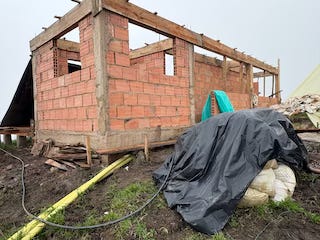
Today, we live in a community of just over two thousand people (San Juanito). To reach the town from Bogotá, one must travel at least 4 hours by car, cross the Chingaza páramo, and likely pass through landslides and roads that are challenging for any vehicle. At the moment, we are building a house in the mountains, where we dream of restoring ten hectares of forest, planting fruit trees, and creating spaces that promote scientific research, environmental education, and perhaps even a tourism hub for the municipality.
Nico has accomplished some amazing things with his work in the Páramo. Some years ago, he learned to pilot an aerial photography drone and made a short (5-minute) documentary about water resources in Colombia, including the Páramo he was studying. This wasn’t the beginning for him, but it certainly furthered his interest and love for working to preserve these important water resources in his country. I felt the video was National Geographic worthy.
Here is the translation for the paragraph posted at the end of the film.
This video shows scenes from different landscapes across Colombia that are connected by the most important resource for life: water. You will see drone footage ranging from the country’s two oceans to its snow-covered mountain peaks, passing through tropical rainforests, high mountain forests, and páramos. It is a tribute to International Water Day, celebrated on March 22.
More recently, Nico’s research was published and featured on the front page of El Espectador, Colombia’s oldest newspaper,..
After the wedding and the party at Café y Crepes - Café de la Montaña, the guests who had not yet departed for the U.S., along with friends and family, gathered to make the trek from Bogotá to San Juanito, where Nico and Maria Emilia currently live. We would spend the first day traveling.
Bright and early Monday morning, we gathered at my brother Dan’s home and boarded a bus that he had chartered for our adventure. It was a holiday in Colombia. One would expect extra traffic, but the “extra” was bicycles. Many streets were closed, and it looked like half the city was out biking. There is a favored route that leads up the mountain to a small town that offers little cafes and shops. It also happened to be our route. I wish I had a photo to show you. Imagine buses and cars and trucks and taxis making their way up the mountain with bicycles everywhere — beside, behind, ahead, winding through the traffic.
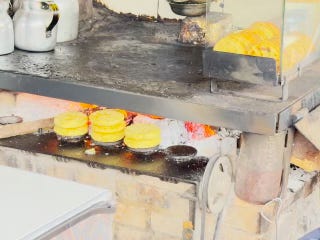
We stopped at one of those little roadside cafes for snacks and toilet breaks. One cafe was making arepas over a wood-fired griddle. I like arepas however they’re made, but these were exceptional! It’s a type of flatbread made from ground maize dough, sometimes stuffed with a filling (usually cheese).
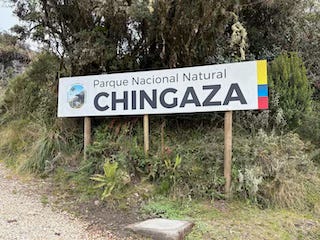
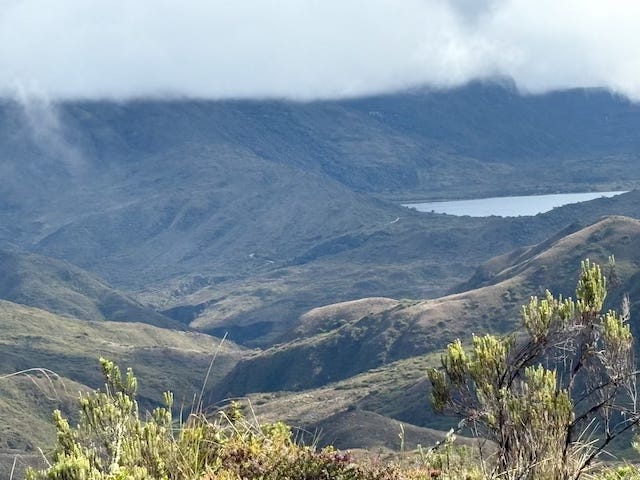
Back on the road. We soon arrived at the Chingaza National Natural Park, located in the páramo region of the Eastern Ranges of the Colombian Andes, northeast of Bogotá. Most of our travel time was through this park.
Come along with me on the bus. I’m warning you, the road is very narrow and bumpy.
We’ll stop now and then to breathe in the magnificence. Sometimes, Nico will share information to help us better understand the significance of this incredible place.
~ Information about the Páramos ~
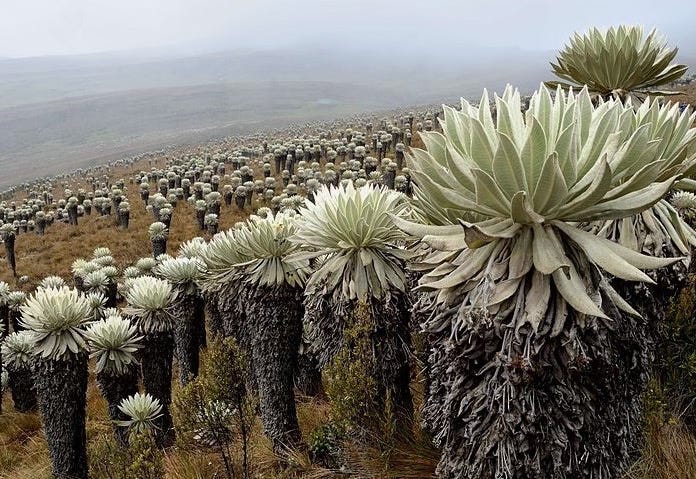
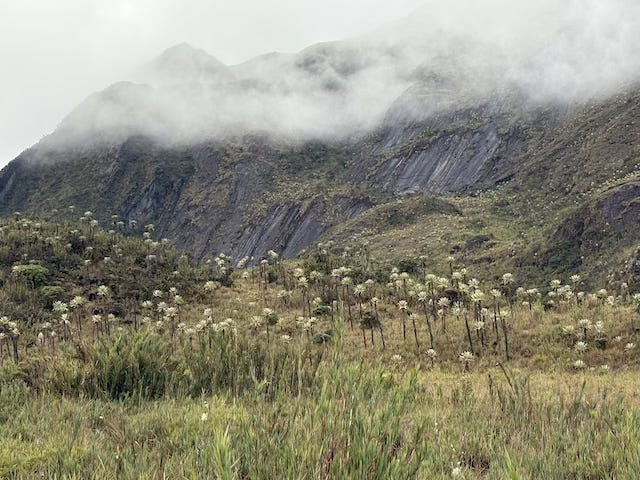
Colombia holds nearly 50% of the world’s páramo ecosystems, covering 11,000 square miles (2.5% of its land) with 36 distinct complexes that supply over 60% of the country’s water. Located in the Andes between 3,000 and 4,000+ meters, these high-altitude, cold, and humid wetlands are characterized by endemic frailejón plants. Major areas include Sumapaz, Chingaza, and Santurbán. (Chingaza is the huge National Park that abuts the land that Nico and Maria Emilia purchased and where they are now building a house.)
Key Aspects of Colombian Páramos
Water Production: Often called “mountain sponges,” they capture moisture from fog and rain, providing essential drinking water for cities like Bogotá.
Biodiversity Hotspot:
Home to unique fauna, including the Spectacled Bear, Andean Condor, and Mountain Tapir.
Unique Flora: The frailejón (Espeletia) dominates the landscape, growing only 1–2.5 cm per year, with some species over 100 years old. These Frailejón wick moisture directly from the clouds as they wend their way through the páramos.
Threats & Conservation: The ecosystems are threatened by agricultural expansion, livestock farming, and mining.
One of the stories my brother and Nico told us regarding the absolute importance of protecting these Páramos is about what happened in Peru and Chile. Because these countries have allowed farming and the mining of minerals (legally and illegally) in their high-altitude Andean wetlands and moorland regions, these regions have been destroyed. Not only in Peru and Chile, but also in neighboring countries. This has contributed to a significant reduction in water supply, creating “dry,” desert-like conditions in formerly high-moisture ecosystems, leading to localized desertification.
While these ecosystems are not turning into sandy deserts, the degradation of their “water-sponge” capacity leads to severe water scarcity, dry soils, and the loss of biodiversity, effectively creating ecological deserts in the high Andes. Additionally, the mining, especially in Peru, has released toxic mercury into rivers, destroying ecosystems and contaminating drinking water for communities.
Like an avalanche, the effects cascade. The extraction of natural resources and the expansion of farming into sensitive areas, such as páramos, degrade soil, which in turn destroys habitats. This leads to displacement and conflict for people, especially Indigenous populations, who face displacement from their ancestral lands. Large-scale mining projects have led to violent protests, as seen in Peru’s copper mining sector, where communities complain of limited compensation and poisoned water.
There are additional social and health issues, such as increased criminal activity, prostitution, and the spread of diseases like malaria. And as we have witnessed repeatedly, local communities often receive few benefits, despite the propaganda used by mining companies when lobbying for mining rights. High-value mining jobs are nearly always temporary and unstable.
My nephew feels passionately about preserving his country’s páramos, to prevent what is happening in Peru and Chile from happening in Colombia. My brother additionally feels strongly about his own country, and especially our home state of Minnesota, where mining companies, which are not even U.S. companies, have fought hard to move into our pristine Boundary Waters Canoe Area. Where our own peat bogs and wetlands are being drained for building, for mining, and for agriculture. They are not dissimilar as a source of water supply in the Midwest U.S. as the páramos are to the Andean mountain regions.
As our own Indigenous people have been trying so desperately to tell us, water is sacred and we must protect it. From mining, from oil pipelines, from all the ways we have polluted it and damaged it. Water is life.
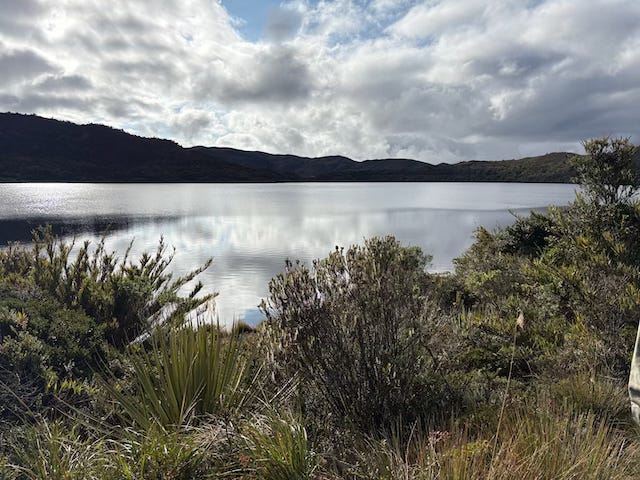
Looking out the bus window, there in the distance is the sacred Laguna Chingaza. Upon our arrival, we stopped to greet and honor the Lake. It was so quiet, only the occasional birdsong. The water is like glass. I sat with my feet in the water, breathing deeply.
Time to go?
Eventually, we exited the Park, leaving behind the “good roads”. As the sun slipped behind the mountains, we wound our way down one side and then up the other, bumping and rocking all the way. We spotted the bean fields on the mountainside that Nico and my brother had described, many of them already harvested. Initially, I thought they were vineyards as the plants grew up the stakes and wound along the ropes. When they’re ready to harvest, they are stripped and piled on yards of black cloth, which draws the sun's heat. The pods begin to break open, and the beans pop out. My brother called them ‘jumping beans.’
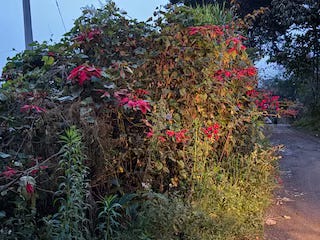
My eye caught a splash of brilliant red across the valley next to a white farmhouse. Clearly, they were some kind of tree with red leaves. I was informed they were Poinsettia trees. Poinsettia trees? Later, I saw others. They grow like our lilac shrubs back home in the Northland of the U.S.: First a bush, then a small tree. But like our potted Christmas plants, these ‘trees’ are covered with red poinsettias. Some are planted intentionally. Others grow wild along the country roadways.
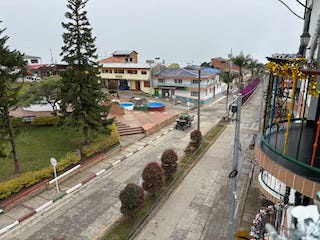
Finally, we pulled into the little mountain village of San Juanito. Hungry, tired, and glad to put our feet on the ground!
View from the balcony of my hotel room…
The next morning saw us well fed — piles of arepas, soups, eggs made to order, coffee, and hot chocolate. The local bakery provided a wide variety of freshly made buns and pastries — and coffee.
Then it was off to climb the mountain where Nico and Maria Emilia are building their home.
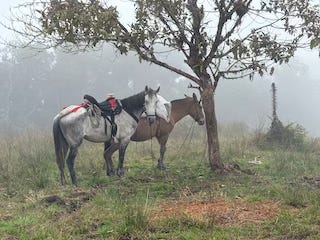
Several cars were involved in transporting us as far as the road went. It ended at the property of Silvio Gutierrez, the man who sold the land to Nico and Maria Emilia. Nico said Mr. Gutierrez has been instrumental in teaching Nico about the land, how to live on it, and how to build on it. He was the person who had the horses and mules who would take us up the rest of the mountain to the site. Well, at least for those of us who didn’t want to hike it.
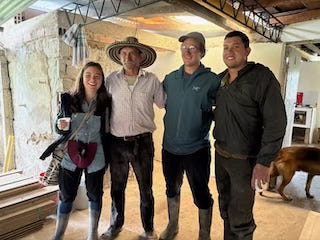
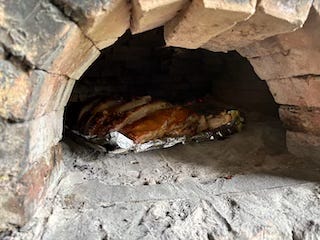
Silvio Gutierrezwith Nico and Maria Emilia. The younger man, Wilson, has worked hard with Nico. He’s a carpenter. He fells the trees, planes the wood, and directs the building of the house. He’s also the village butcher, and he, his mother, and Mr. Gutierrez roasted a pig and prepared a feast for us while we climbed the mountain and explored Nico’s land.
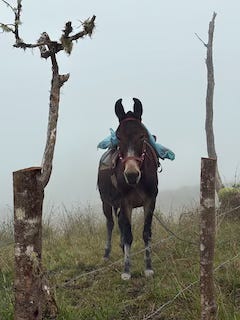
The mules and horses have been hauling all the needed building materials, tools, tents, etc., up the mountain for months. Sometimes they’ll make the trip ten times a day. We were assured that they’re smart, they know the way, and we can trust them.
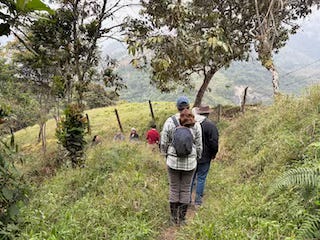
The path up to Nico’s land winds its way up the mountain, crosses a stream, and is sometimes very steep and rocky. At other times muddy. Then it opens up into a hilly meadow.
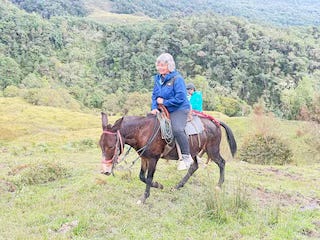
They put me on a mule. She was sweet and smart, and in the end, I was so grateful for her.
David was given Nico and Maria Emilia’s horse, Gandalf (because he’s Grey). I was a little jealous as I wanted to ride Gandalf.
Off we went. My molly tried hard to be at the head of the string. But eventually gave way to the others. She was confused, thinking we were going to a different place, and tried a few times to head down this incline. She eventually listened to my urging (especially after Nico yelled at her in Spanish) and stayed on the track. She was a gentle soul.
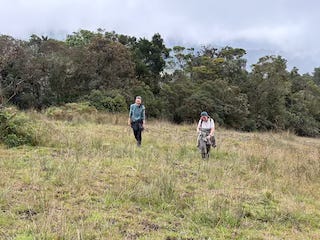
We riders got up to the half-built house first and watched as the others gradually straggled in.
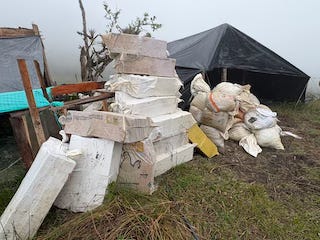
We were given the grand tour and told the stories of what it has been like to haul everything up the mountain that is needed to build a house, with all its infrastructure —water, sewer, electricity, internet — all the things needed for modern living—and then to build it.
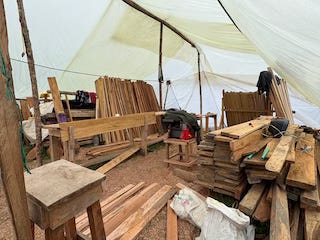
The huge tent where all the wood is stored that has been cut, planed, and readied for the floors and trim, and some of the walls
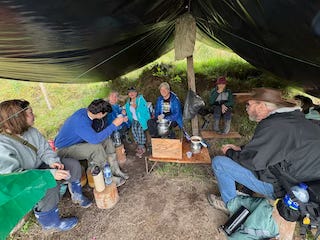
The temporary kitchen where we gathered for coffee and snacks.
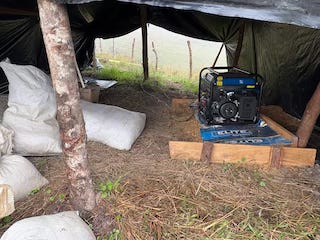
The large, very heavy generator. Until their solar is set up, and they eventually get local power up the mountain, this is their energy source. Carried up the mountain attached to two long poles pulled by mules in front and men holding the poles from behind. Having just come up the mountain on the mule, I could hardly conceive of the idea of hauling all this stuff up there by mules and carrying it on your own back. Maria Emilia talked about one day when she was exhausted and still carrying a heavy load on her back. I think it was raining, and she slipped and fell at one point and felt like she’d never get up again. “I was pretty crabby that day,” she said. It is a beautiful place and an amazing dream…but one realized through a lot of blood, sweat, and tears. I can envision them sitting up here on their mountain at the end of a difficult day, wondering if it is really worth it. And I know they will put their arms around each other and say, “Yes. It is worth it.”
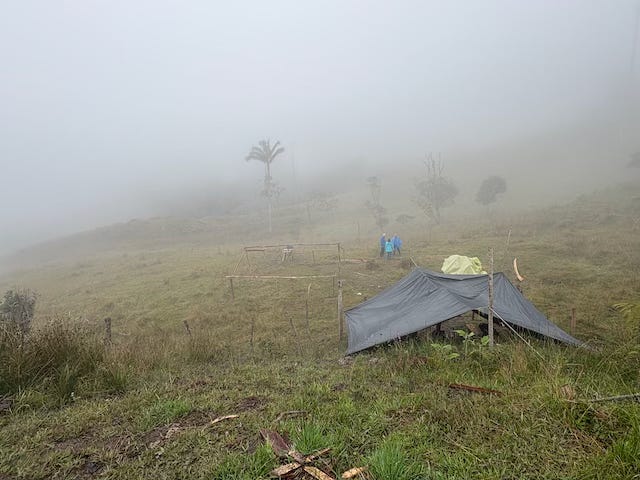
Looking down from the house, over the roof of the temporary kitchen tent, and to the part of their land where they hope to put in a pond.
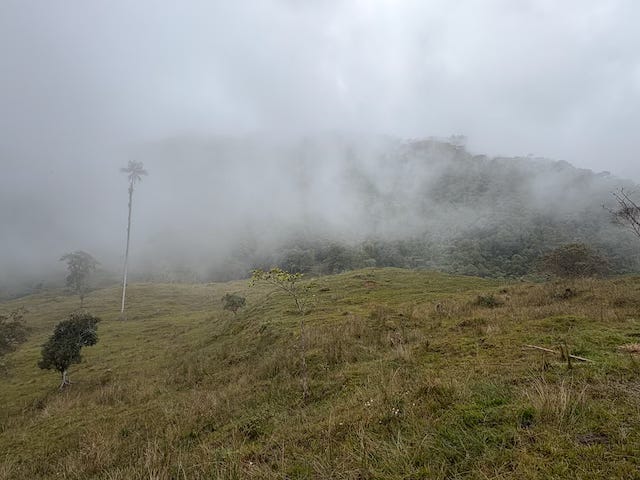
Looking up the mountain from the site of the house. Though obscured by the clouds, this is the forested part of their land. This is where they get the wood for the house. This is the “cloud forest” they hope to preserve and expand. Most of our group hiked up into the forest. I was a bit weary and chose instead to wander around near the house and sit, drinking in the view.
Men at work laying the flooring for the living room part of the house.Nico sent me this recently, letting me know the work continues.
Once everyone was back, we prepared to depart down the mountain. I was nervous about riding down those steep inclines. Nico showed me how to lean back in the saddle as far as possible when it got steep. As we left, my molly was once again determined to be at the head of the string. This time, she held her own. She knew where we were going. Occasionally, when she would bump her way down a particularly steep and tricky part, I would whimper. But Nico would call out, “You’re doing great, Aunt Mary! You’re doing great!”
Once we cleared the stream and rounded a bend, Nico warned us that the horses and mules might get a bit frisky. And indeed they did. They picked up their pace. I figured it was because we were getting close to home. They began vying for pack leader position. Suddenly, Gandalf, the horse David was riding — the one I’d been a little jealous about him getting to ride instead of me — broke past all of us and took off. David had lost his left stirrup and had no purchase. Nothing he did would slow Gandalf down. Nico was shouting at Gandalf and took off after them. David was yelling. Nico was yelling. My molly recovered her place at the head of the string and kept the others from following Nico and David.
A few minutes later, we rounded a bend, and there was David lying on the side of the road, and Nico checking him over. Gandalf was nowhere to be seen. David kept saying he was okay…banged up, scraped up, bruised ribs on his left side, but nothing broken. I was relieved.
Interestingly, my molly stopped about 5 yards from them, which halted the string. She was observing the situation. She stood there for several minutes before deciding everything was okay and continuing on. She kept a moderate pace. We came around another bend, and there was Gandalf, eating the grass on the side of the road. About ten yards beyond him was the gate and the driveway up to Don Silva’s. She stopped again across from Gandalf, stared at him, and then she tossed her head and walked on, through the gate, up the driveway, and right up to the post where she’d been tied when I was helped onto her back. It was almost as if she disapproved of what Gandalf had done and maybe telepathically let him know it.
David’s explanation was that he knew that he was going to fall off, or get tossed off, so he fell back on a lesson he had learned in the past — how to safely make an emergency exit off a horse that desires to unseat you. His teacher had been a large Friesian mare who loved to scrape her rider off against a tree or a shrub. So, in this situation, he’d chosen to make his exit on his terms rather than wait for Gandalf or fate to jettison him.
Once all the excitement had settled, we were welcomed into the makeshift dining room for a feast of roasted pork, salads, yucca root (like baked potatoes), guacamole, and roasted corn. Other neighbors and men who had been helping with Nico’s building project came, some with their families. It was a party! And the beer flowed freely!
The party over, the guests departed. The rest of us piled into the cars arranged for us to take us back to San Juanito.
The next morning held more adventures. I had thought we’d head back to Bogotá early, but instead, we left on an excursion to view a grotto and a waterfall and see more of this breathtaking mountain countryside.
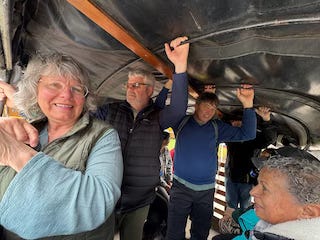
The first adventure was surviving the journey in the back of a truck. Remember, I mentioned that the mountain roads are rutted and narrow, making for a bumpy ride? Try navigating it standing up in the back of a truck! (Although I found it easier than sitting down!)
I can’t show you what I saw on the way to our destinations. My hands were occupied in hanging onto the truck! I wish I could have, as the beauty of these mountains is stunning. Being at the front, I was able to look out over the truck's cab and see the expanse of the mountains, near and far. Once, the truck had to stop because a nanny goat was tied to a stake by the side of the road, while her babies wandered about. They had no comprehension of the danger we posed. But their momma did and let them know quickly enough. What a racket she made! After a few minutes, the kids tumbled over each other, running back to her, and we continued. Later, there were a couple of cows on the steep side of the road. They watched us go by, quietly chewing their cud. The mountains surrounded us as we drove the switchbacks and down into the valleys and up again.
We stopped on a narrow bridge spanning an extremely deep, narrow crevice, 40 meters (over 40 yards). It is a haunted place. Many suicides have occurred here. But worse, between 1995-2001 the guerrilla FARC controlled the area and as punishment to some farmers they would throw people off this bridge. I felt a wave of sadness roll through me.
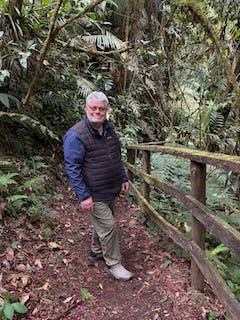
Eventually, we came to the place where the mountain river tumbles down over and under the rocks. La Gruta. It was a short hike down the mountainside to get there. Most of it was easy to navigate (except for the thinning oxygen). Then the path narrowed to a few feet wide, hugging the mountain on one side and falling away on the other. It was also muddy, as it was so humid and wet from the waterfall's mists.
Brother Bob…
Brother Dan…
La Gruta…
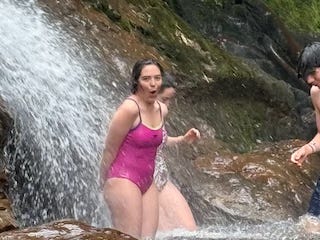
Next stop? Where the falls create a swimming hole. I’m not sure where I was that I hadn’t gotten the memo to bring a swimsuit or at least a change of clothes… I was very sad to not be able to join the fun!
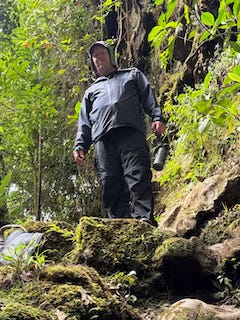
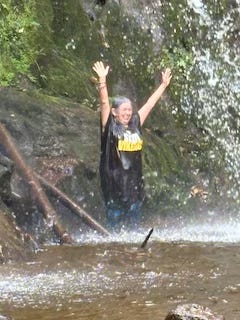
After we climbed back up from the grotto, we stopped at another falls. This is the one where my brother had thought we’d all like to swim. But now those who might have, were chilled. They’d had their fun. They were done. These mountain streams are not like taking a warm shower! So, Nico gave us a demonstration of what we were all missing.
Finally back to San Juanito.
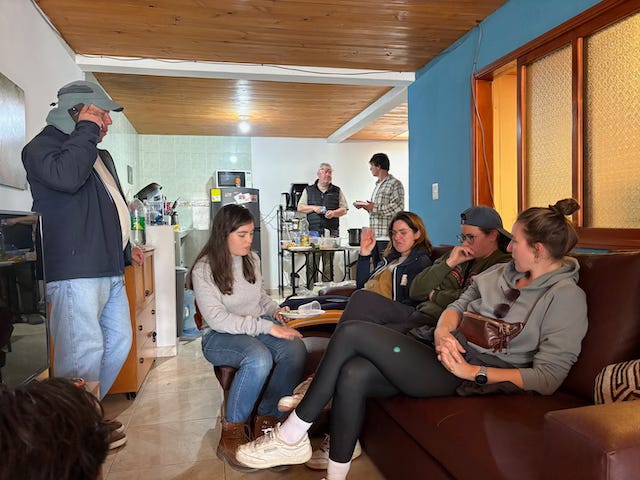
We had lunch at Nico and Maria Emilia’s apartment while we waited for our bus driver to gas up for our return to Bogotá. None of us were quite sure why he hadn’t taken care of this early in the morning, or even the day before. But, by the time he got around to it, the one gas station in the village was closed and wasn’t going to open again until after 2:00. Evidently, the owner had other things to attend to?
Finally underway. The group was a little quieter after such a busy morning, and with the shadows lengthening. We watched the sun setting in the mountains.
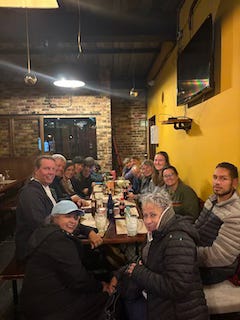
We stopped for dinner at one of my brother Dan’s favorite places along this route. The food was delicious!
Early the next morning, most of the rest of us were on our way back home. Some onto further travels.
David and I were headed back to Chicago to spend a few more days with my oldest daughter and her family, including my granddaughter’s 12th birthday. Unfortunately, 30 minutes before we landed at O’Hare Airport, my body turned on a faucet, and my nose began to run. I was sneezing and wheezing.
Whatever “bug” I’d picked up, I shared it with the family. Happy Birthday, Rowen.
Family. The bonds that connect us are certainly much deeper than the names we share or where we hang on the Family Tree. They are psychic, spiritual, emotional, and physical. Can anyone love us or wound us more deeply than family? This time in Colombia was filled with adventures and fun, dancing, hiking, and partying, good food, and fun games. But more than all of that was the renewal of our shared connection. The deepening of the love we have for one another.
We don’t all see the world the same. We have different views and opinions. We have had different experiences. Much of our life is lived apart from each other. There are old wounds that some of us carry that haven’t been healed. But still, what I witnessed was profound, deep love. What wounds and disagreements exist are borne because we care so deeply. The joy we feel is multiplied because it is shared. The wedding ceremony that Nico and Maria Emilia planned shone a big spotlight on this fact — how much our family matters. And that Love is above all things. It is Love that nurtures life, Love that heals wounds, Love that connects us all to one another.
Thanks for reading A Spoonful Of Light! Subscribe for free to receive new posts and support my work.