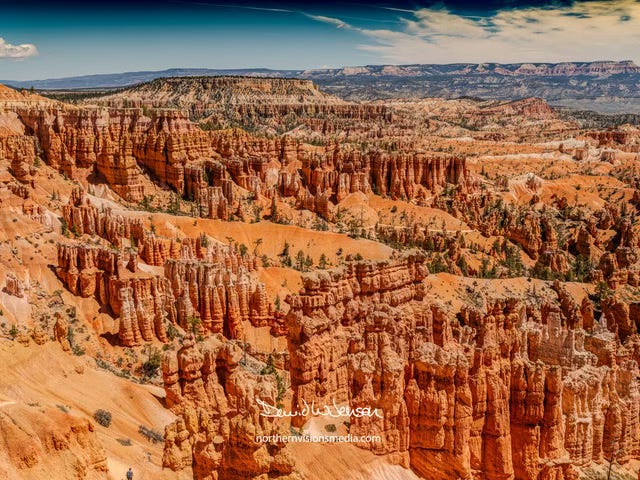
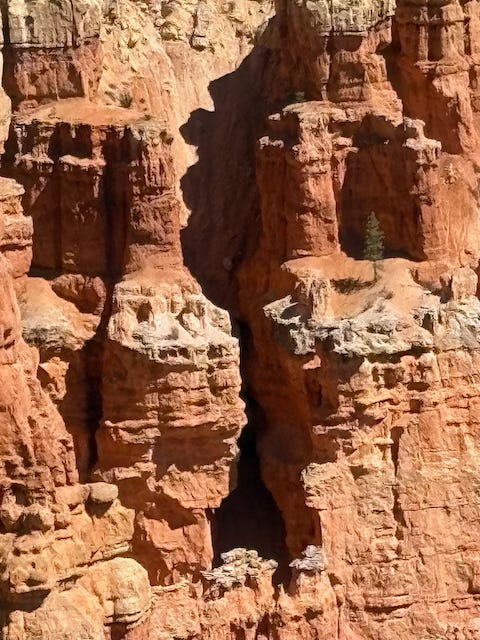
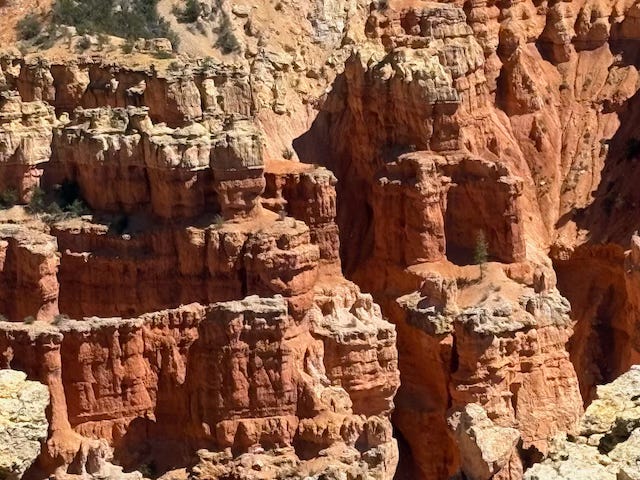
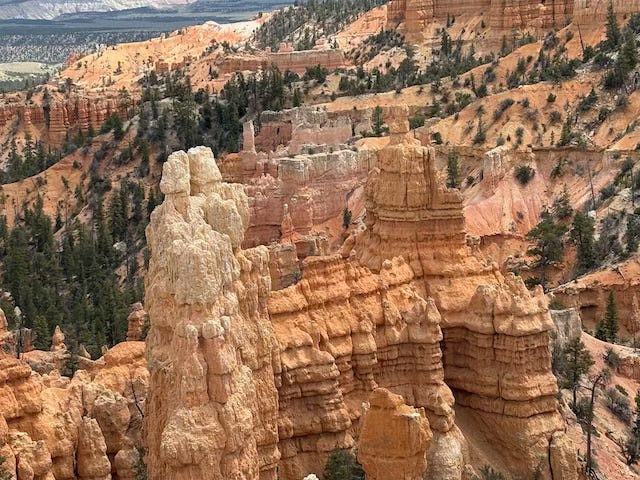
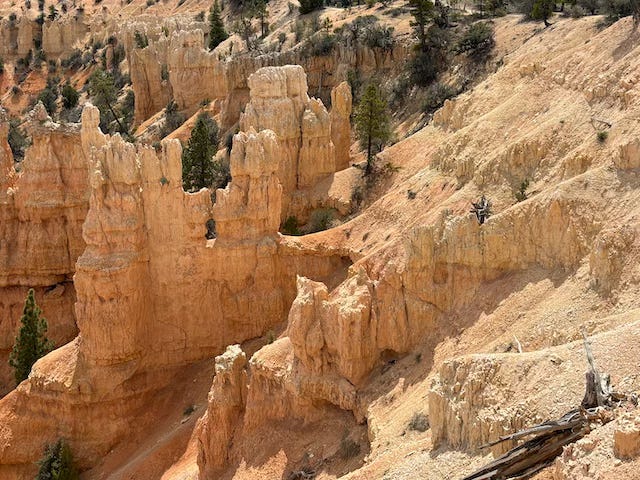
After my “day off” on Wednesday, I was ready to go see Bryce Canyon. I’d caught glimpses of these slabs of red rock emerging from the hills that have slowly eroded away over the millions of years since they were tossed up from deeper in Mother Earth’s womb. They would suddenly be around a bend or over an incline on our way into this area, both before and beyond the Slot Canyon we’d explored on Tuesday.
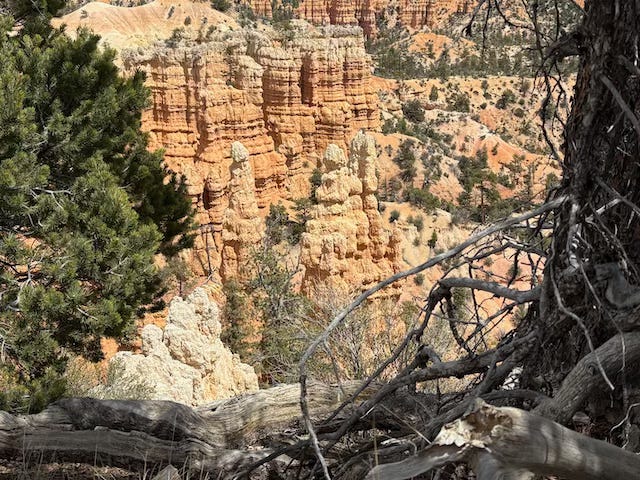
But I had not yet stood on the rim of what is called the Amphitheater of Bryce Canyon.
Thanks for reading A Spoonful Of Light! Subscribe for free to receive new posts and support my work.
I walked slowly along the Rim Trail for a while, breathing in this strange magnificence.
I imagined the slow melting away of the sandy hills over time, revealing these strange rocks hidden inside. I noticed places where you could see the beginnings of this phenomenon and wondered how many thousands of years will pass before these baby hoodoos just emerging will look like the full-grown ones that surround them.
I thought about the Indigenous people who lived here before European settlers moved in with their customs and cattle and imagined entitlements.
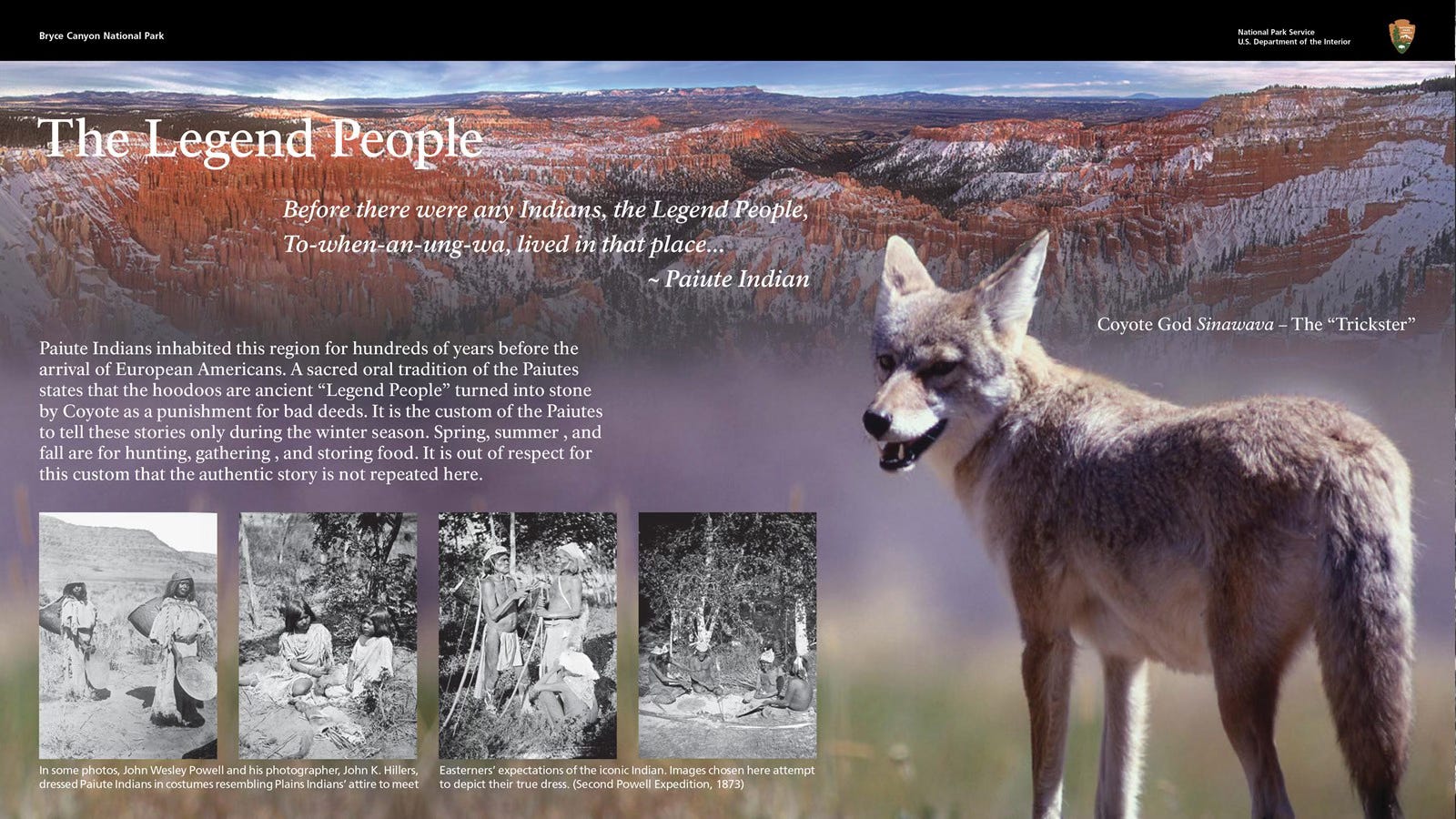
They were the Paiute Indians who lived here hundreds of years before white settlers came. Their sacred oral traditions included a story about the “Legend People” who inhabited this region long before their own time. It is said they were punished by the Coyote God, Sinawava - The “Trickster” - for living too heavily upon the land. He turned them into stone, thus their explanation for the towering hoodoos filling these canyons.
It reminded me of the belief of the “Desert People,” of the Tohono O'odham Nation in the Sonoran Desert of Arizona, who consider the Saguaro to be their ancestors.
In the Visitor Center (I love going in these centers and reading all the information…I learn so much! Now, if I could just remember it all!) I came across this sign…
The text under the old photos disturbs me. It reads:
In some photos, John Wesley Powell and his photographer, John K. Hillers, dressed Paiute Indians in costumes resembling Plains Indians’ attire to meet Easterners’ expectations of the iconic Indian. Images chosen here attempt to depict their true dress. (Second Powell Expedition, 1873.)
I am glad the current curators saw fit to find images of these people in their authentic dress. But I feel again the sting of what the European settlers from whom I am also descended, thought they had the right to do to people who didn’t look or behave as they did, who did not fit into their image.
For example, how did this canyon come to be named Bryce? The Southern Paiute people historically refer to the area of Bryce Canyon as Unka-timpe-wa-wince-pock-ich, which translates to "red rocks standing like men in a bowl-shaped recess" or "red rocks many standing holes". They also call the rock formations Uru, in reference to their legends of people turned to stone.
Ebenezer Bryce (1830–1913) was a Scottish immigrant, Mormon pioneer, and rancher who settled near the canyon in 1875. He built a road to timber, an irrigation canal, and a homestead in the area. Locals called the distinctive amphitheater "Bryce’s Canyon" because he grazed cattle there and described it as a "hell of a place to lose a cow". I wonder if the settlers didn’t know what the Paiute’s called it, or found it easier to remember and pronounce an English name.
On Friday we went to see the Mossy Cave which took us down into the canyon. Now we were looking up at the towering hoodoos and canyon walls. I liked this perspective. I felt part of the Earth I was walking through and upon, rather than a spectator looking down. The waterfall, which is fed from the Tropic Ditch canal was pretty weak. Like so much of the southwest we’ve been through, drought has been rough. And this winter has been the “winter that wasn’t” according to local folks.
This Tropic Ditch canal was quite an engineering feat back in 1889. Mormon settlers dug a 10-mile-long ditch beginning in September 1889, completing it in May, 1892. The men apparently used hand tools, teams, and blasting to divert water from the East Fork of the Sevier River through the mountains, allowing it to flow into the Tropic Valley.
The ditch was built to supply water to the town of Tropic and secure agricultural growth. The canal diverts water over the cliffs of Bryce Canyon, creating the Tropic Ditch Waterfall near the Mossy Cave trail.
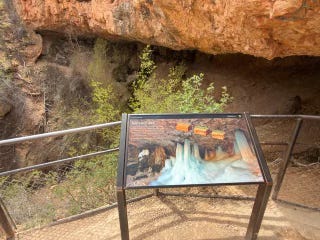
The Mossy Cave would be far more impressive in winter, I think. Its a shallow, inset in the canyon wall through which water seeps continually. In winter it creates spectacular ice stalactites. The rest of the year it waters the moss that clings to everything. The water continues to seep unseen down through the tiny cracks and crevices in the rock and then pours out the bottom, creating a small stream which flows down to the creek that flows from the waterfall. As this creek collects other runoff streams, it widens, but the stretch along which we walked was never more than ankle deep.
We made one last stop before saying goodbye to the hoodoos and cliffs and wildlife of this place. Fairyland. I searched to find out how it got its name. On the northern end of the park, it is set apart from the busier Amphitheater area. Like the rest of the canyon, it is whimsical and otherworldly. But according to a story posted on the Bryce Canyon Park’s Facebook page in 2023, here is how the name for this area came to stick.
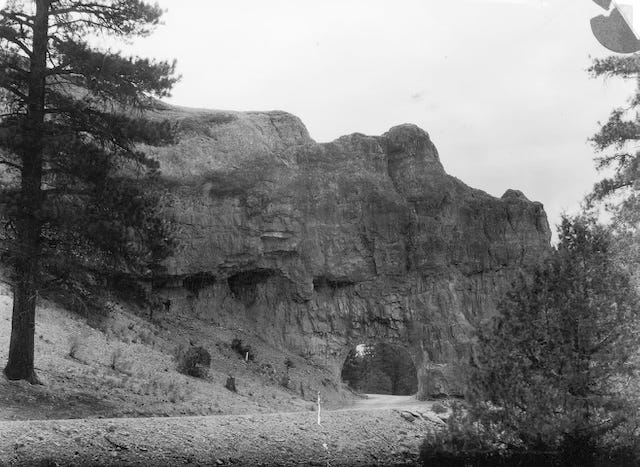
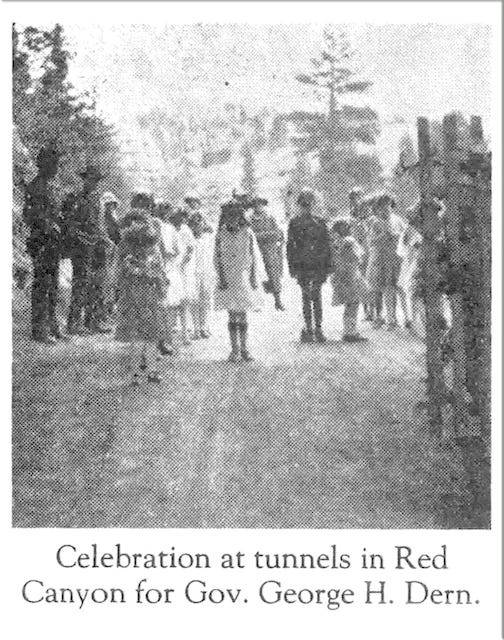
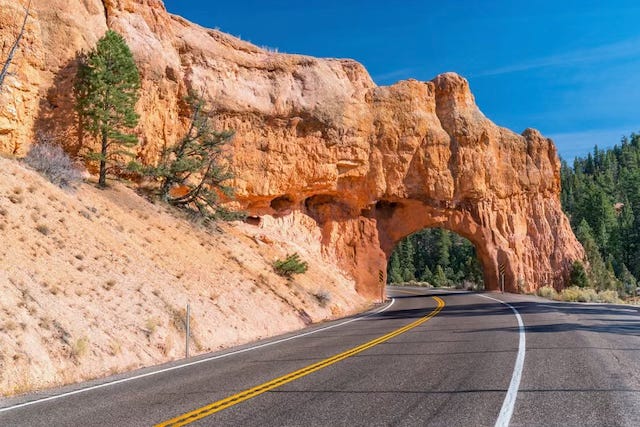
Since Bryce Canyon National Monument was established in 1923, the vast majority of its visitors have travelled through Red Canyon to get there. Its twin rock tunnels have served as an unofficial gateway to the park for nearly 100 years--and one day, 98 years ago, quite literally so.
On June 1st, Utah Governor George Dern led a caravan of 315 cars through Red Canyon to celebrate the opening of Bryce Canyon’s 1925 season. But as they passed through the first tunnel, they found the second one barred with a gate of flowers and evergreen boughs.
As the caravan halted, a young elf stepped forward and attached a floral bouquet with long streamers to the governor’s car. He then climbed onto the hood and gave a signal. From everywhere local children dressed as fairies and elves began to appear. One fairy hopped onto the car’s running board and asked Governor Dern if he believed in fairies.
“Yes,” he said.
“Then,” she said, “enter into Fairyland.”
Two elves opened the botanical gates while a local band perched atop the tunnel began to play. Dancing fairies pulled on the streamers (as adults pushed from behind) to draw the car through the tunnel beneath a huge banner reading “Welcome to Utah’s Fairyland”.
As they passed through the tunnel, surprise and satisfaction were evident on the faces of the Governor and his wife. He was heard to say, “I have never been more happily surprised in my life than at this moment!”
I found a shady spot on the edge and sat.
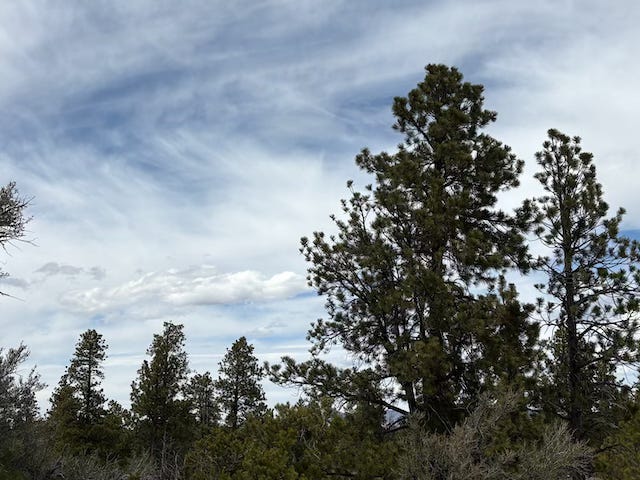
I watched the birds cavorting in the skies while the clouds wandered about.
Tomorrow we leave for the Salt Lake area. We are supposed to camp up in the mountains above Ogden, but the weather app says it is going to snow up there, and rain like crazy in the town. The other campground is on Antelope Island in the Salt Lake. However, other RV folks who’ve been there recently are reporting swarms of midges that bite. Hmmmm…
Thanks for reading A Spoonful Of Light! Subscribe for free to receive new posts and support my work.